Beamlines
Ultrafast THz spectroscopy Beamline
Ultrafast Terahertz time-domain spectroscopy (THz-TDS) represents a very powerful tool in the family of time-resolved optical techniques for the study of these phenomena. The main advantage of THz-TDS is the possibility to directly measure both the amplitude and phase of the THz electric field by exploiting the Pockels effect in an electro-optical crystal. The retrieval of the entire waveform of the electric field allows us to obtain the real and imaginary parts of the dielectric response without the need for Kramers-Kronig transforms. By varying the delay between a pump used to excite the system and the THz beams that probe the response of the sample, it is possible to capture its transient dielectric response that describes the underlying fundamental physical and chemical properties.
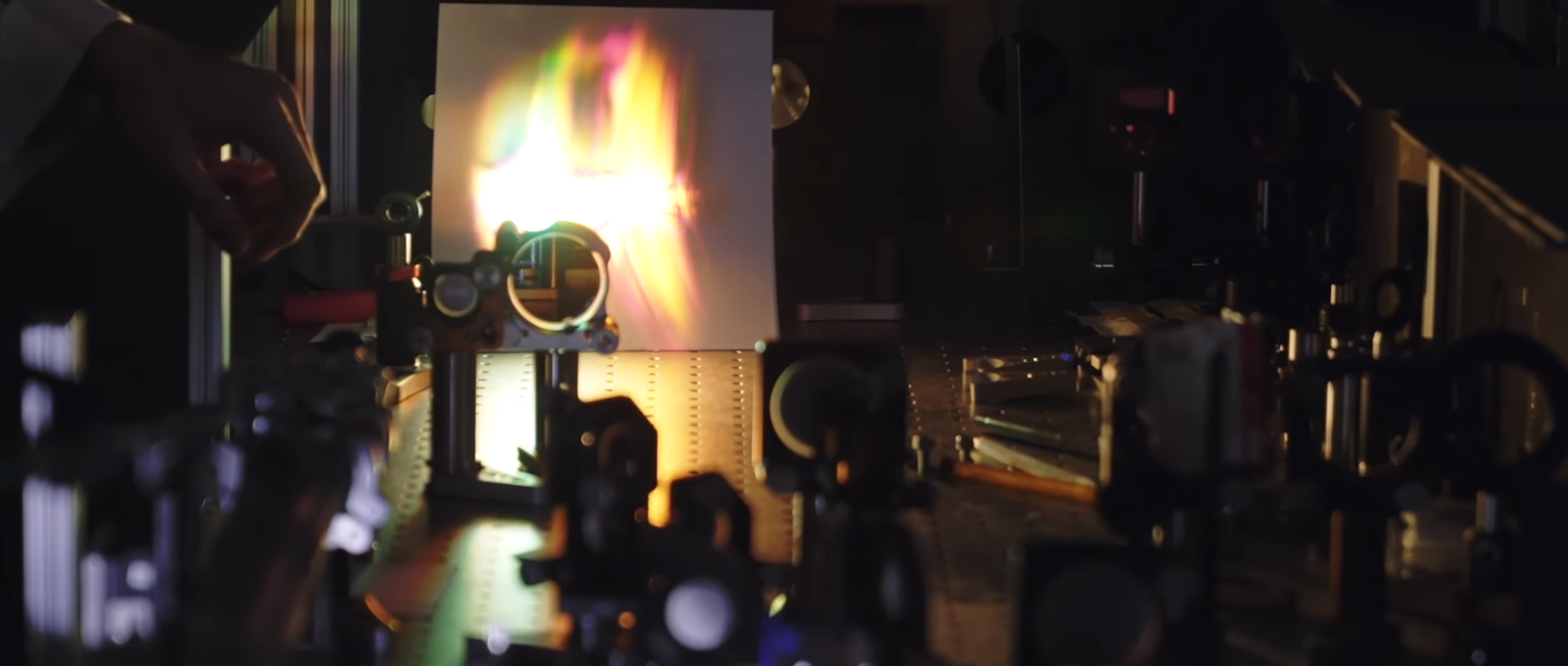
We seed our Optical Pump – THz probe (OPTP) setup with 100 fs pulses from a 5 kHz solid state Yr amplified laser system with a center wavelength of 1030 nm. The THz-TDS spectrometer is equipped with GaP crystal for the generation of few-cycle THz pulses with a 0.5-8 THz bandwidth (15-260 cm-1, 2-33 meV) that are delivered to the sample with a system of 90° off-axis parabolic mirrors. Pump beams in the visible/NIR range are generated by a home-build Optical Parametric Amplifier (OPA) seeded by the same amplified laser system. The setup can operate in transmission and in reflection mode with fast switching between the two configurations. The temperature can be controlled in the 5-500 K.

Beamlines che fanno questo
Donec vel pretium sapien. Curabitur et sollicitudin nibh. Quisque dapibus imperdiet augue, at ornare ante viverra non. Proin egestas bibendum lorem, nec aliquam ex convallis quis. Integer bibendum, magna et iaculis maximus, est est placerat risus, vel porta erat ligula sit amet nunc.
HHG spectroscopy of solids
High-order harmonic spectroscopy in solids represents a powerful tool to explore the interaction between condensed matter and strong laser field, aiming to constitute an all-optical method to characterize materials, as well as to build new optoelectronic devices able to operate even in the petahertz regime. Additionally, because of this strong interaction, it is possible to study out-of-equilibrium properties of solids and peculiar quantum effects in condensed matter, such as Berry phase effects and Weyl Fermions.
When strong mid-IR pulses illuminate the solid-state sample, the electrons start to oscillate inside the crystal in a sub-cycle time scale. These extremely fast oscillations correspond to highly non-linear currents that generate the high harmonic field.